
Feb. 2, 2026, 7:56 a.m.
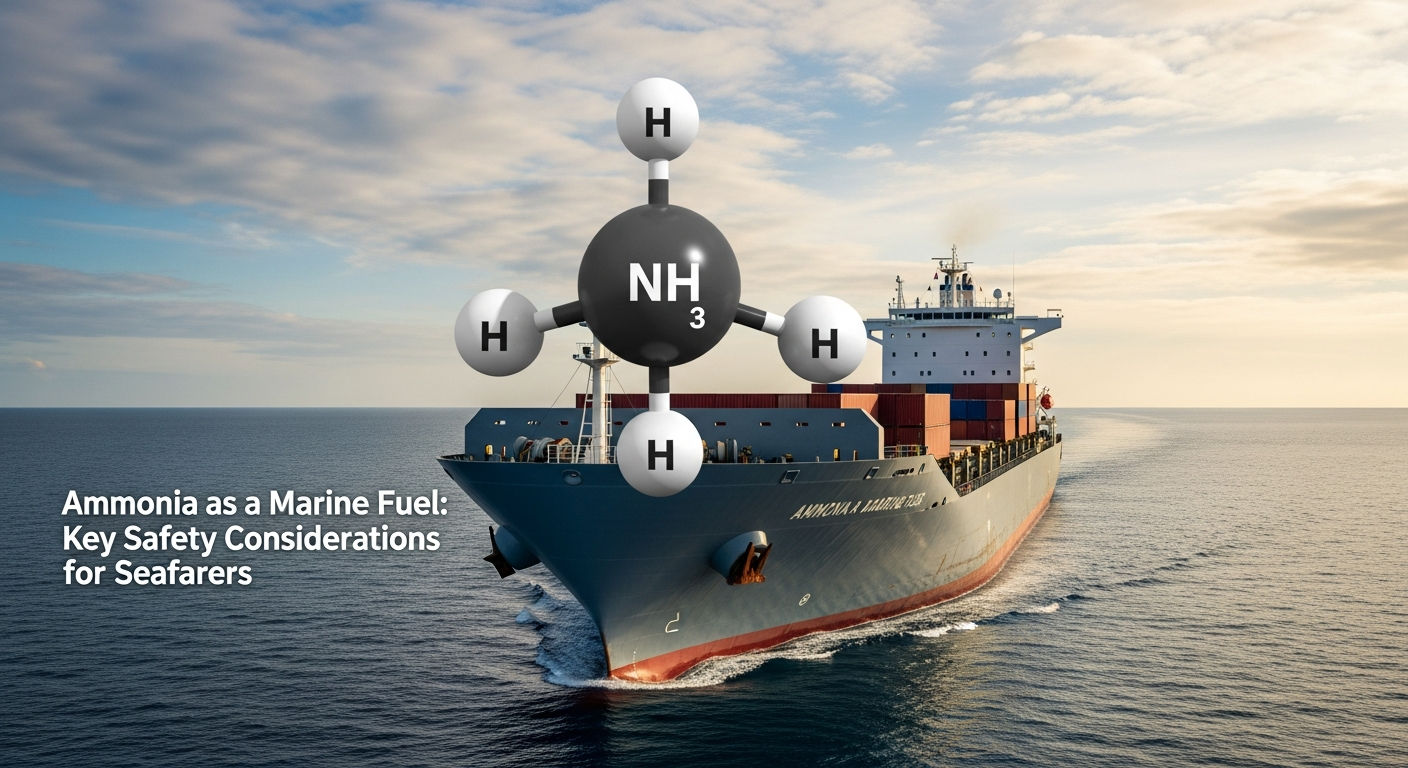
The maritime industry is actively pursuing decarbonization goals set by the International Maritime Organization (IMO), with ammonia emerging as a promising zero-carbon fuel option. Unlike traditional marine fuels, ammonia (NH3) contains no carbon, so its combustion produces no CO2 emissions when burned in engines or used in fuel cells. This makes it attractive for achieving long-term sustainability targets in shipping. However, ammonia introduces unique safety challenges that seafarers must understand and manage carefully.
Main Properties and Advantages of Ammonia as Fuel
Ammonia is a colorless gas with a strong, pungent odor at room temperature. It is stored as a liquid under moderate pressure or at low temperatures (around -33°C at atmospheric pressure). When produced from renewable sources (often called green ammonia), it supports a full lifecycle with minimal greenhouse gas emissions.
Key benefits include:
- Zero direct CO2 emissions during combustion.
- Established global production and transport experience (ammonia has been carried as cargo on ships for decades).
- Potential for cost-effective storage compared to some other alternatives like hydrogen.
- Compatibility with internal combustion engines under development by major manufacturers.
These features position ammonia as a viable pathway for reducing shipping's environmental footprint, especially on deep-sea routes where battery or other options may not suffice.
Primary Safety Risks
The main hazard with ammonia is its high toxicity. Even low concentrations can pose health risks to crew members. Exposure limits are strict: occupational exposure should not exceed 20-50 ppm over short periods, while levels above 300 ppm can become immediately dangerous to life or health (IDLH), causing severe irritation to eyes, lungs, and skin, or even fatalities in higher amounts.
Ammonia is also corrosive, attacking metals, seals, and coatings if not properly managed. It dissolves easily in water, forming alkaline solutions that harm marine life in case of spills. Although ammonia is not highly flammable (ignition range 15-28% in air, high auto-ignition temperature around 651°C), it can pose explosion risks in confined spaces with sufficient oxygen and an ignition source.
Other concerns include:
- Potential for leaks during bunkering, storage, or engine operation.
- NOx emissions during combustion (requiring after-treatment like Selective Catalytic Reduction).
- Risks to air quality if unmitigated, as incomplete combustion or slippage can contribute to secondary pollutants.
Studies indicate that without proper controls, widespread adoption could impact public health through air pollution, though advanced engine designs and regulations can reverse this to net positive outcomes.
Essential Safety Measures Onboard
Safe use of ammonia demands specialized ship design, systems, and procedures. Key elements include:
- Containment and Detection: Double-walled tanks, secondary barriers, and rapid leak detection sensors with alarms. Ventilation systems must dilute and remove any released gas effectively.
- Hazardous Zones: Restricted access to toxic and hazardous areas, with safe havens (gas-tight spaces) for crew during emergencies.
- Personal Protective Equipment (PPE): Full-face respirators, chemical suits, and emergency escape breathing apparatus must be available and used during high-risk tasks like bunkering or maintenance.
- Emergency Response: Detailed plans for leaks, fires, or spills, including shutdown systems, water deluge for dilution, and evacuation protocols. Training must cover recognition of ammonia's odor as an early warning.
- Material Selection: Compatible, corrosion-resistant materials for pipes, valves, and engines to prevent degradation.
Crew training is critical. Seafarers need specific competence in ammonia properties, handling, leak response, and system operation, beyond standard IGF Code knowledge for low-flashpoint fuels.
Regulatory Framework
The IMO has advanced safety rules for alternative fuels. Interim Guidelines for the Safety of Ships Using Ammonia as Fuel (MSC.1/Circ.1687, approved in 2025) provide a framework covering design, installation, operation, and emergency measures. These build on the IGF Code principles (for gas fuels) and allow voluntary adoption while full amendments develop.
Class societies (DNV, Lloyd's Register, ABS, Bureau Veritas) offer notations and guidelines for ammonia-fueled vessels, emphasizing risk assessments, alternative design approvals, and crew competencies. European Maritime Safety Agency (EMSA) studies further detail hazards, modeling leaks, and system operability.
Flag states and operators must integrate these into Safety Management Systems (SMS), with regular drills and audits.
Ammonia holds strong potential as a sustainable marine fuel, but its toxicity and corrosiveness require rigorous safety protocols, advanced engineering, and thorough seafarer training. With proper design, detection, and response measures in place, risks can be managed to levels comparable to or better than other alternatives. Seafarers play a central role in safe implementation through vigilance, adherence to procedures, and continuous learning.
As the industry transitions, staying updated on evolving regulations and best practices will ensure ammonia contributes positively to a zero-emission future without compromising crew or vessel safety.
There are no comments.
Similar Posts
-
Understanding the Hydrostatic Release Unit for Liferafts
Oct. 31, 2025, 9:07 a.m.
-
Navigating New Horizons: Key IMO Regulatory Changes for Seafarers in 2025
Oct. 21, 2025, 8:04 a.m.
-
Methanol and Ammonia Fuels: From Concept to Reality
Aug. 20, 2025, 8:41 a.m.