Feb. 14, 2026, 11:09 a.m.
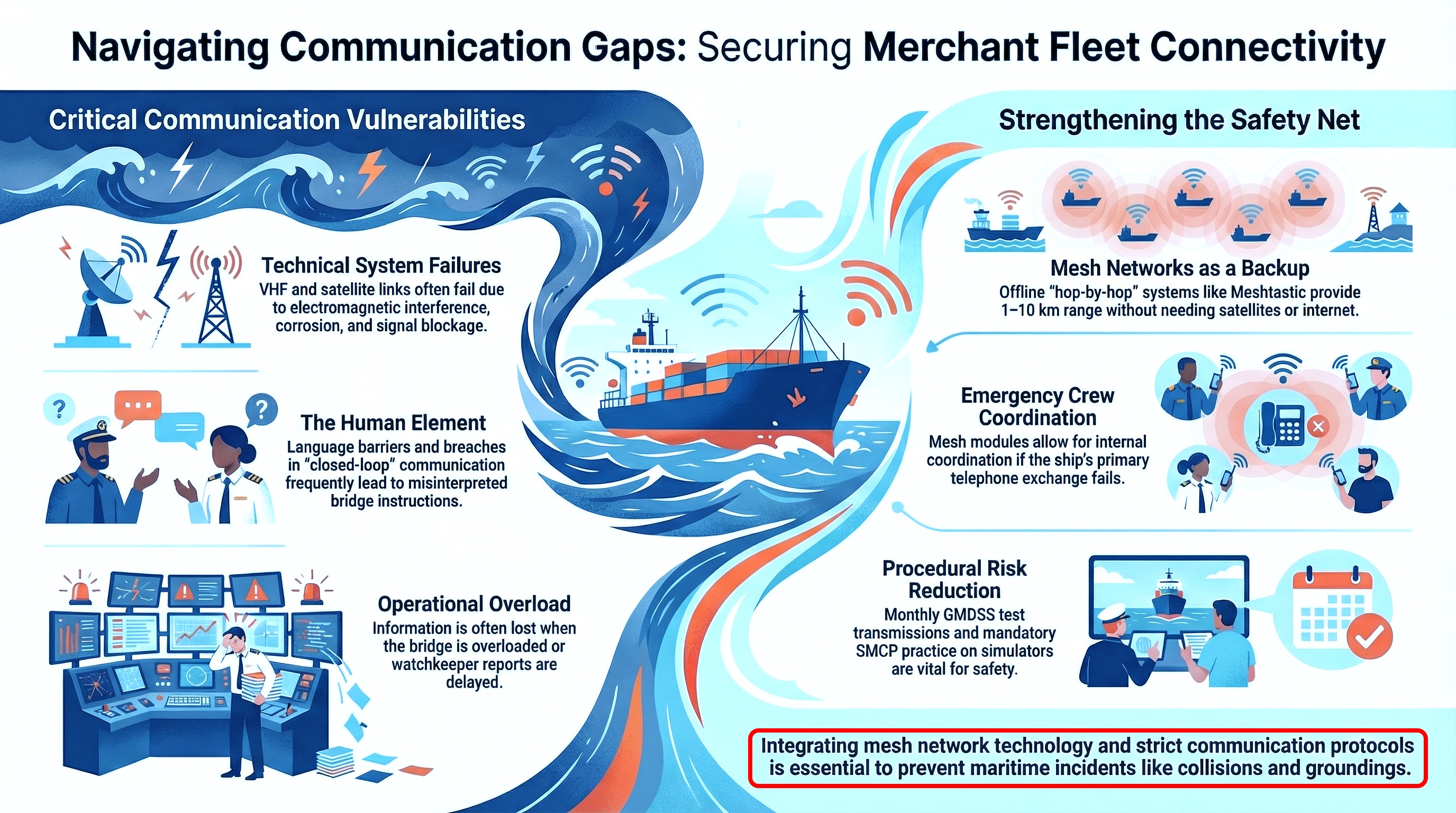
Reliable and uninterrupted communication remains a critical element of safe merchant fleet operations. Despite technological advancements, crews continue to face technical and organizational challenges in the field of communications.
Main Communication Channels Onboard
Modern vessels employ several independent systems:
- VHF (Very High Frequency) — for short-range communication (with other vessels, port services, pilots, tugs);
- MF/HF (Medium/High Frequency) — for long-range communication via shore radio stations;
- Satellite systems (Inmarsat, Iridium, VSAT, Starlink, etc.) — voice, data, internet;
- GMDSS (Global Maritime Distress and Safety System) — automatic distress alerting, reception of NAVTEX, MSI, EGC.
Each channel has its characteristic vulnerabilities.
Typical Technical Failures
VHF radios frequently fail due to:
- electromagnetic interference from radar, AIS, gyrocompass, engines;
- corrosion and mechanical damage to antennas;
- water ingress into coaxial connectors and feeders;
- improper configuration or software glitches.
Satellite antennas lose lock because of heel, rolling, icing, atmospheric precipitation, or signal blockage by superstructures. False distress alerts in GMDSS are still reported due to operator errors or sensor malfunctions.
Language and Procedural Barriers
On multinational crews, English remains the primary working language, but proficiency levels vary widely. This leads to:
- misinterpretation of instructions and reports on the bridge;
- errors during VHF negotiations (especially with pilots and VTS);
- difficulties in transmitting technical information between watchkeepers.
Many incidents (collisions, contacts, groundings) include communication failures in their causal chain. Standard Marine Communication Phrases (SMCP) help, but their practical application is often not strict enough.
Internal Shipboard Communication Problems
Even with functioning external links, issues arise within the crew:
- incomplete or delayed information transfer between watches;
- breach of closed-loop communication (lack of order repetition and confirmation);
- bridge overload with tasks, causing important messages to be “lost”;
- in the engine room — delayed or incomplete reports on malfunctions.
Mesh Messengers Concept as a Backup Channel
In recent years, vessels have begun testing and implementing mesh networks based on applications such as Meshtastic. These solutions operate without internet or satellites:
- devices exchange messages directly or via a chain of other devices within a 1–10 km radius (depending on equipment and antennas);
- data is transmitted on a “hop-by-hop” principle — each phone/module relays packets;
- offline operation is possible inside the vessel and between vessels in line-of-sight range;
- low power consumption, interference resistance, and complete independence from shore infrastructure.
Mesh solutions are particularly useful:
- during total failure of satellite communication and GMDSS;
- in areas with strong interference or signal blocking;
- for internal emergency crew coordination (if the ship’s telephone exchange fails);
- as a backup channel for sending short text messages and coordinates.
Recent developments, including integrations with systems like Signal K for off-grid boat telemetry, demonstrate growing practical adoption in maritime environments.
Recommendations for Risk Reduction
- Conduct monthly checks and test transmissions across all GMDSS channels;
- Mandatorily practice SMCP on simulators and in real scenarios;
- Implement checklists for VHF communications and critical maneuvers;
- Train crews in closed-loop communication principles;
- Consider installing mesh systems (e.g., LoRa-based) as an additional backup communication layer.
Clear, timely, and redundant communication often proves the decisive factor between incident prevention and escalation.
There are no comments.
Similar Posts
-
STCW Updates 2025-2026: What Actually Changed and How to Keep Your Certificates Valid
Nov. 30, 2025, 11:47 a.m.
-
Enhancing Maritime Safety: Addressing Human Factors in Vessel Collisions
Sept. 6, 2025, 11:31 a.m.