Feb. 6, 2026, 7:16 a.m.
The Ship Master, commonly known as the Captain, holds the highest-ranking position aboard a merchant vessel. This role carries ultimate authority and full legal responsibility for the ship, its crew, passengers, cargo, and the marine environment. Achieving the rank of Captain requires many years of dedicated service, continuous professional development, advanced certifications, and proven leadership under pressure. While the position offers prestige, high earnings, and respect, it also demands constant vigilance and accountability for every aspect of the vessel’s operation.
Path to Becoming a Ship Master
The journey to command begins with solid academic preparation and progresses through structured sea service and examinations.
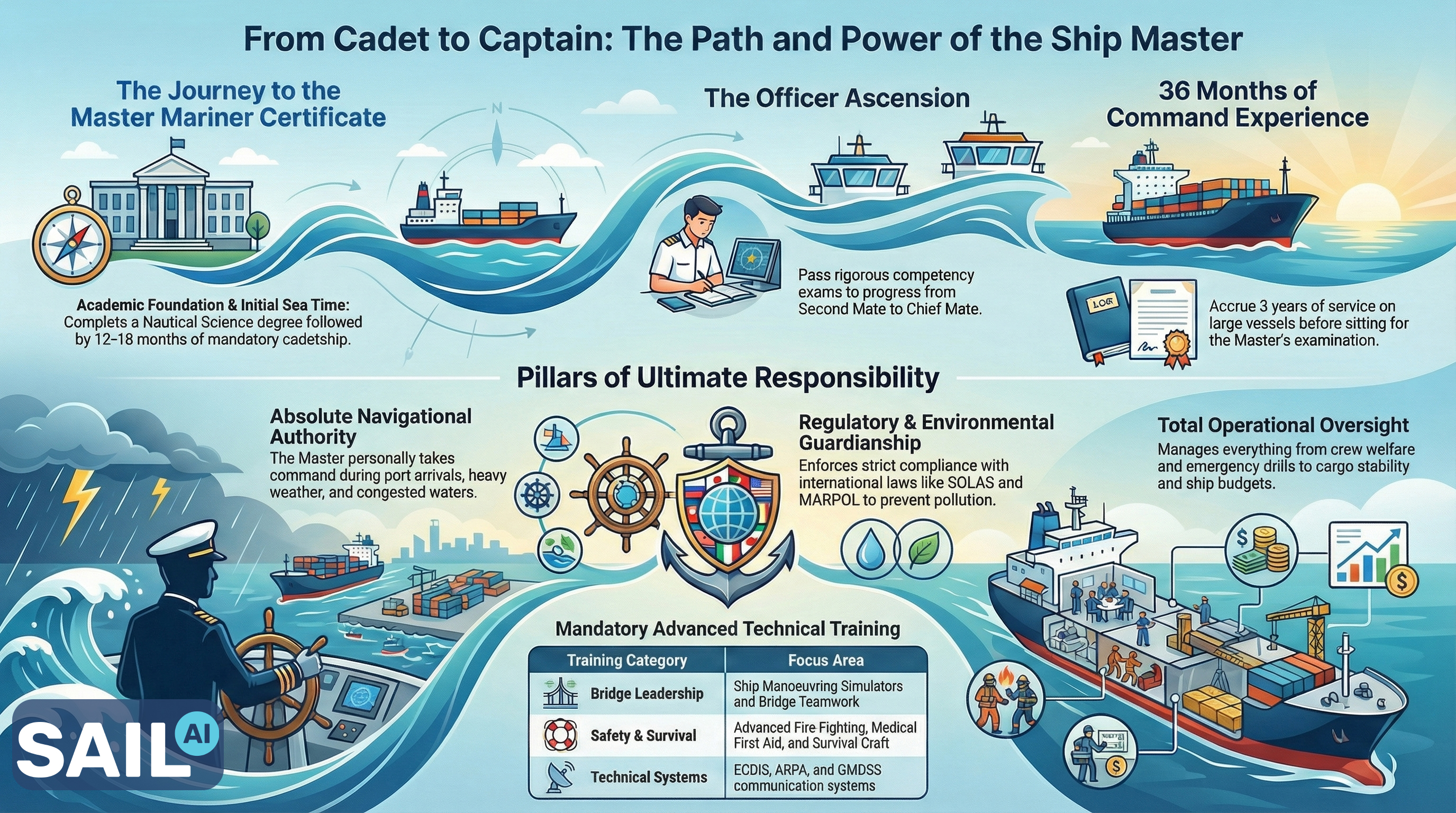
Most future captains complete secondary education with strong grades in physics, chemistry, and mathematics. They then enroll in maritime programs such as a Diploma in Nautical Science or a Bachelor of Science in Nautical Science. After graduation, cadets complete mandatory sea time (usually 12–18 months depending on the program) under the guidance of experienced officers.
Following initial sea service, officers must pass the Second Mate Certificate of Competency examination, which includes written, oral, and practical components. After gaining further experience as a Third and Second Officer, they move on to Chief Mate training and examinations. Only after accumulating sufficient sea time (typically at least 36 months on vessels of 500 GT or more, with strict requirements on larger ships), completing advanced courses, and passing the Master’s examination can an officer receive the Master Mariner Certificate of Competency.
Additional mandatory training includes:
- Advanced Shipboard Management
- Ship Manoeuvring Simulator and Bridge Teamwork
- ECDIS (if not previously completed)
- Other STCW-mandated courses (Advanced Fire Fighting, Proficiency in Survival Craft, Medical First Aid, GMDSS, ARPA, etc.)
Core Duties of the Ship Master
The Master is responsible for the overall safety, navigation, and efficient operation of the vessel. Key responsibilities include:
- Ensuring safe navigation in all conditions. The Captain personally takes the con during port arrival and departure, passage through congested waters, heavy weather, or other critical situations.
- Approving and continuously monitoring the voyage plan prepared by navigation officers.
- Leading and managing the entire crew, maintaining discipline, resolving conflicts, and promoting teamwork across diverse nationalities.
- Ensuring full compliance with international maritime regulations, including SOLAS, MARPOL, ISM Code, STCW, and flag state requirements.
- Preventing pollution by enforcing strict garbage management, oil record book procedures, emission controls, and ballast water handling.
- Supervising cargo operations to guarantee safe loading, stowage, securing, and unloading. The Master verifies that the vessel’s stability remains within safe limits at all times.
- Overseeing the condition of the ship, including structural integrity, equipment maintenance, life-saving appliances, and firefighting systems.
- Organizing and evaluating regular emergency drills (fire, abandon ship, enclosed space entry, medical, piracy, etc.).
- Responding decisively to emergencies such as fires, medical evacuations, collisions, grounding, or man-overboard situations.
- Coordinating with port authorities, pilots, agents, charterers, and flag state inspectors. Although a pilot may provide navigational advice in restricted waters, the Master retains full command and legal responsibility.
- Managing crew welfare, including work/rest hour compliance, medical care, mental health support, and fair treatment.
- Handling port documentation: customs, immigration, port clearance, crew lists, ISPS security declarations, and logbook entries.
- Controlling the vessel’s operational budget, approving purchases of stores, spares, provisions, and arranging necessary repairs.
- Ensuring safe handling and segregation of dangerous goods according to the IMDG Code.
Final Thoughts
The role of Ship Master represents the pinnacle of a seafaring career. It demands technical expertise, strong decision-making skills, emotional intelligence, and the ability to remain composed in critical situations. Every choice made on board directly affects human lives, valuable cargo, the environment, and the reputation of both the Master and the company.
For aspiring seafarers, the path to command requires patience, lifelong learning, and genuine commitment to safety and professionalism. Those who reach this level truly embody the spirit of leadership at sea.
Resource: Adapted from Marine Insight
There are no comments.
Similar Posts
-
Denmark Deploys Ice-Strengthened Accommodation Vessel for Military Personnel in Greenland
Feb. 6, 2026, 7:43 a.m.
-
Understanding General Purpose Rating: Your Entry to a Maritime Career
Oct. 24, 2025, 9:03 a.m.
-
STCW Updates 2025-2026: What Actually Changed and How to Keep Your Certificates Valid
Nov. 30, 2025, 11:47 a.m.
-
Human Capital in the Green Transition: Preparing the Future Maritime Workforce
May 25, 2026, 6:31 p.m.