June 1, 2026, 8:04 p.m.
Operational Safety and Risk Management Guide for Deck and Engine Officers
Introduction
In maritime operations, technical complexity means that the safety of a vessel relies heavily on the continuous functionality of thousands of interconnected mechanical components. Even the smallest component, when compromised, can initiate a rapid sequence of events leading to catastrophic consequences. This educational case study examines a real life incident where the malfunction of a single small valve resulted in the sudden grounding, subsequent sinking, and the eventual multi day closure of a critical commercial shipping channel. For seafarers and engineering professionals, this scenario serves as a powerful lesson in systems architecture, emergency response, and the absolute necessity of rigorous planned maintenance systems.
The Chain of Events
The incident began during routine navigation within a restricted commercial channel, an environment that demands maximum steering precision and responsive speed management. While navigating the narrow passage, the vessel experienced a sudden and unexplained drop in propulsion speed. The unexpected reduction in engine revolutions per minute compromised the hydrodynamic flow over the ship rudder, causing an immediate loss of effective steerage. Unable to maintain its intended course within the narrow confines of the fairway, the vessel drifted out of the deep water channel and ran hard aground.
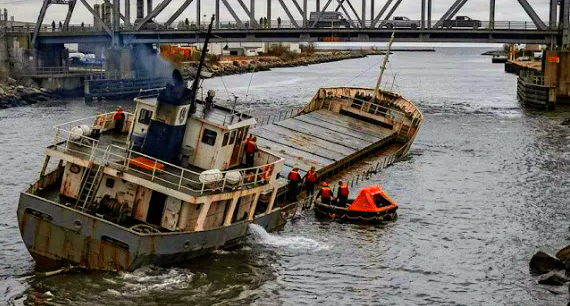
The grounding introduced immediate hull stresses and localized damage. In an effort to stabilize the ship and mitigate the list resulting from the impact, the shipboard crew immediately initiated emergency ballast operations. The crew began pumping ballast water with the direct intention of correcting the physical tilt of the hull. Meanwhile, the vessel slowly maneuvered against the protective fenders of an adjacent bridge structure located on the opposite side of the channel, seeking to secure the hull and prevent further uncontrolled movement.
Despite the efforts of the crew to stabilize the vessel alongside the bridge fenders, the structural integrity of the hull had been severely breached during the initial impact or subsequent grounding stresses. Progressive flooding soon overwhelmed the internal bilge and ballast pumping capacities. The vessel eventually lost all buoyancy and sank to the bottom of the shallow channel. Fortunately, the ship settled on an even keel without capsizing, allowing for a controlled and safe evacuation of all crew members. However, the position of the sunken hull created an immediate hazard to navigation, forcing authorities to close the commercial shipping channel to all traffic for approximately four days until the vessel could be stabilized and moved.
The Root Cause: A Single Point of Failure
A comprehensive marine accident investigation was launched to identify the technical trigger behind the initial loss of propulsion. Investigators focused their attention on the main engine propulsion control systems, specifically looking into why the vessel suffered a sudden reduction in speed while transitioning through a high risk navigation zone. The physical evidence revealed that the underlying cause was not a major mechanical breakdown of the engine cylinders, nor was it a catastrophic structural failure of the crankshaft.
Instead, the entire accident sequence was traced back to the unintentional operation of a small shut off valve connected directly to the main engine speed governor system. The speed governor regulates fuel delivery to maintain the desired engine output based on bridge or control room commands. The unexpected closing or failure of this minor valve restricted or disrupted the governor control medium, causing the mechanism to automatically reduce the main engine speed to a minimum or idle state. This mechanical disruption happened so rapidly that the watchkeeping officers had insufficient time to diagnose the issue, override the automated control loop, or deploy alternative stopping measures before the vessel drifted out of the safe fairway.
Technical Lessons for Seafarers
This incident offers several critical learning points for both marine engineers and deck officers working on modern commercial vessels:
- Identification of Single Points of Failure: Shipboard engineers must thoroughly understand the control loops of critical machinery. Any small component, such as an isolated needle valve, a shut off valve, or a pneumatic regulator that can directly cause an engine shutdown or speed reduction must be clearly identified and labeled as a critical system element.
- Safeguarding Critical Controls: Valves that control fluid or pneumatic lines linked to governors, quick closing systems, or safety trips must be physically protected against accidental contact or incorrect alignment. Proper locking mechanisms, warning tags, and strict valve management protocols should be implemented onboard.
- Redundancy and Manual Overrides: Watchkeepers must be trained to quickly transition from automated control modes to emergency manual overrides. When an engine speed drop occurs in a restricted fairway, every second counts. Knowing how to bypass a malfunctioning governor control circuit can prevent a grounding.
- Maintenance Protocols for Minor Components: Planned maintenance systems often focus heavily on major components like pistons, turbochargers, and large pumps, while neglecting small auxiliary valves. This incident proves that auxiliary valves require regular inspections, function testing, and overhaul schedules to ensure they do not fail or vibrate loose during operation.
Emergency Response and Channel Management
Once the grounding occurred, the situation escalated rapidly into a sinking scenario. For deck officers, this highlights the necessity of accurate damage stability assessments. Flooding calculations must be performed immediately upon grounding to determine whether the vessel has sufficient residual stability to remain afloat or if moving the ship will worsen the intake of water. In this case, the decision to maneuver toward the bridge fenders managed to keep the vessel upright as it sank, preventing a much worse capsize situation that would have completely blocked the channel for weeks or months instead of days.
The four day closure of the commercial shipping route resulted in severe economic consequences for the port region and shipping lines, demonstrating how a single mechanical oversight can quickly escalate into a massive financial and logistical liability for the ship owner and international maritime trade.
Resource: Summarized from official marine accident investigation data regarding critical valve failures and propulsion loss, originally documented and reported by Marine Insight.
There are no comments.
Similar Posts
-
Maritime Safety Analysis: Cargo Vessel Loss During Super Typhoon Gaemi
April 23, 2026, 6:48 p.m.
-
International Regulations for Safe and Efficient Container Shipping at Sea
Feb. 16, 2026, 7:31 a.m.
-
Vessel Seeks Shelter in Spanish Port After Severe Container Collapse During Storm
Jan. 20, 2026, 9:27 a.m.