
Dec. 27, 2025, 3:32 p.m.
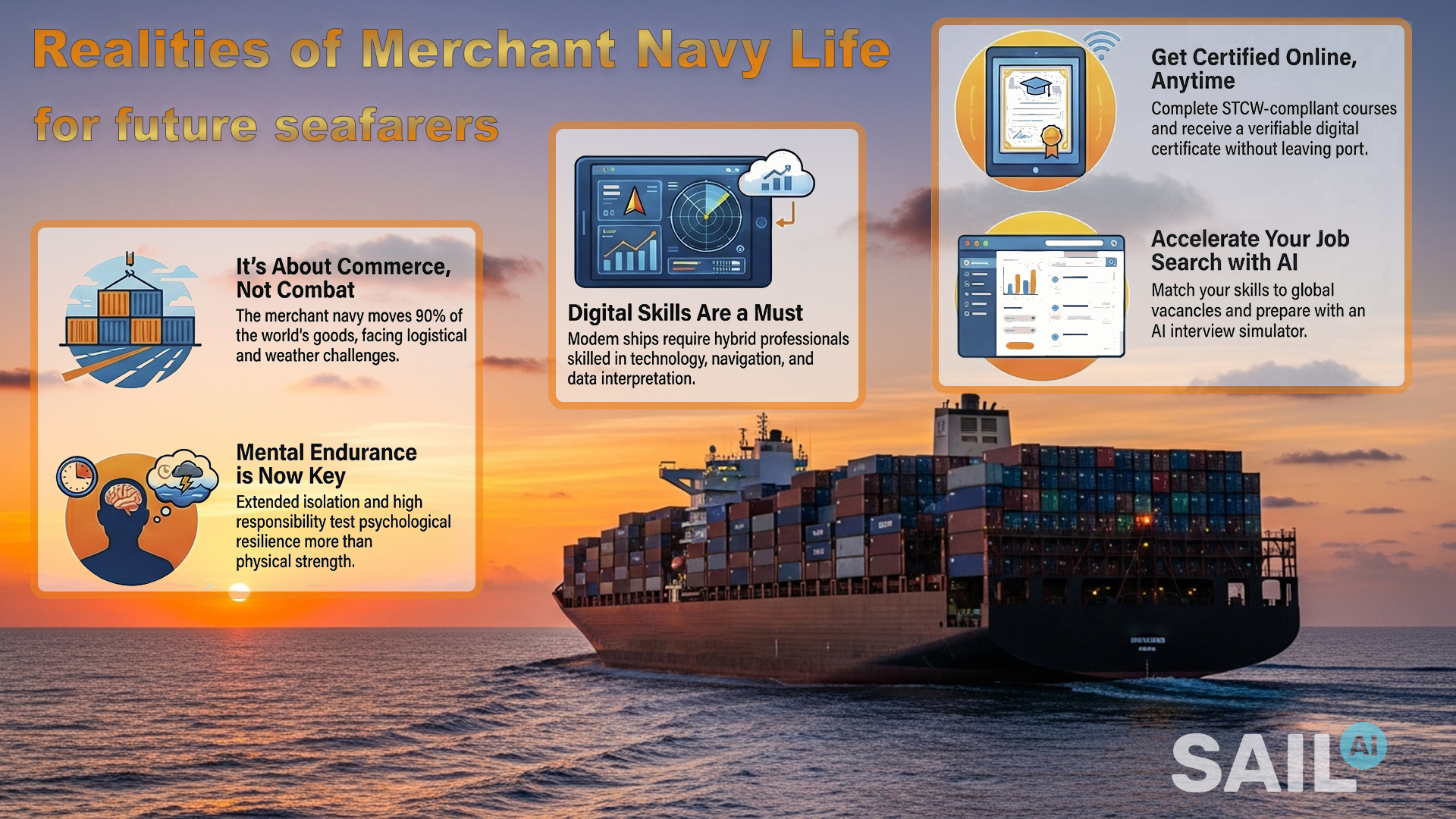
A career in the merchant navy serves as a key pillar of global trade, yet many people hold misconceptions about this profession. It is frequently mistaken for military service or viewed as a never-ending adventure full of travel. In reality, life at sea combines high responsibility, unique challenges, and deep professional satisfaction. This article highlights ten important aspects that every future seafarer needs to know before embarking on this path.
1. Trade, Not Warfare The merchant navy focuses entirely on commerce. Civilian crews operate various vessels such as container ships, oil tankers, bulk carriers, and general cargo ships, moving around 90% of the world's goods across oceans. Seafarers deal with severe weather, strict schedules, complex logistics, and occasional security threats like piracy. Unlike the defence navy, which uses warships to guard national borders, the merchant navy has no combat role. Though both share similar ranks, uniforms, and discipline, their fundamental goals remain completely different.
2. The Travel Dream Has Evolved The idea of leisurely exploring exotic ports belongs mostly to the past. Today's shipping industry prioritises speed and efficiency. A large container vessel may spend less than a day in port, unloading and reloading cargo before departing again. Many modern terminals sit far from city centres in industrial zones. As a result, seafarers often glimpse new countries only from the ship's bridge, deck, or through a porthole, with very limited time ashore.
3. High Pay Comes as Compensation for Sacrifices Salaries in the merchant navy tend to exceed those in most land-based jobs, frequently arriving tax-free depending on nationality and contract terms. However, experienced mariners see this income as fair compensation rather than simple earnings. It balances the cost of missing family milestones, enduring long periods of separation, disrupted sleep patterns, and the inability to return home after a workday. Recent updates to the Maritime Labour Convention (MLC 2006), including 2025 amendments, have strengthened protections regarding repatriation, social security, and fair shore leave, ensuring better overall welfare.
4. The Most Diverse Working Environment Merchant ships have long embraced true multiculturalism. A standard crew of around 20 members may represent five or six different nationalities, each contributing specialised skills across departments. Seafarers quickly adapt to varied languages, cultural habits, food preferences, and communication styles. This daily cooperation builds exceptional tolerance and a truly international outlook rarely found in other professions.
5. Mental Endurance Matters More Than Muscle While deck and engine work still demand physical effort, modern shipping relies heavily on mental strength. Extended isolation from loved ones, constant responsibility for valuable vessels in unpredictable conditions, and the pressure of decision-making test psychological resilience. The industry now places greater emphasis on mental health resources. Advances such as high-speed satellite internet (e.g., Starlink) enable regular video contact with home, but seafarers must balance this connectivity to avoid new forms of fatigue and maintain strong onboard relationships.
6. The Hidden Force Behind Everyday Life Practically every item around you, from your smartphone and clothing to food and car fuel, has likely travelled on a merchant ship. The global economy depends on reliable, just-in-time deliveries by sea. Should commercial shipping pause even briefly, supply chains would collapse, stores would empty, and production would stop. Seafarers carry the quiet knowledge that their work keeps modern society functioning.
7. Heavy Regulation Goes Beyond Basic Safety Shipping ranks among the most strictly controlled industries worldwide, overseen by the International Maritime Organization (IMO) and numerous conventions. Officers devote considerable time to documentation, audits, and compliance with rules on pollution prevention (MARPOL), safety (SOLAS), and security (ISPS). Mistakes can result in expensive vessel detentions. In 2025, new IMO requirements for reducing greenhouse gas emissions push the sector toward alternative fuels like methanol and ammonia, requiring continuous learning and adaptation.
8. Welcome to the Age of Smart Shipping Gone are the days of traditional navigation tools alone. Today's bridge resembles an advanced control centre, equipped with electronic chart systems (ECDIS), radar, AIS, and real-time satellite links. Shore-based teams monitor vessel data continuously. Future seafarers must combine classic maritime knowledge with strong digital and analytical abilities, evolving into hybrid professionals skilled in technology, navigation, and data interpretation.
9. Sea Experience Opens Doors Ashore A life at sea does not trap anyone there forever. The skills gained, including leadership in high-pressure situations, technical expertise, and crisis handling, prove highly valuable on land. Many former seafarers successfully move into positions such as fleet superintendents, port managers, maritime consultants, lawyers, insurance specialists, and logistics executives. The merchant navy often becomes a powerful launchpad rather than a lifelong commitment.
10. Unparalleled Crew Bonds Few workplaces create connections as strong as those formed at sea. When facing powerful storms far from land, the crew truly becomes a second family. Mutual dependence for safety and daily operations builds deep trust and lasting friendships. Veterans frequently recall their sailing years with fondness, cherishing the special sense of unity and shared purpose that defines life aboard.
A merchant navy career offers unique rewards along with serious demands. It requires discipline, adaptability, and emotional strength. For those suited to this lifestyle, it provides not just a job, but a profound and meaningful way of life.
Source: Adapted and expanded from Marine Insight articles on merchant navy careers and realities (marineinsight.com)
There are no comments.
Similar Posts
-
Role and Responsibilities of the Second Engineer in the Merchant Navy
Oct. 30, 2025, 5:59 a.m.
-
Global Energy Shift: The Rise of Atlantic Basin Tanker Routes
April 22, 2026, 6:32 p.m.
-
11 Astonishing Ocean Phenomena Every Seafarer Should Know
Jan. 27, 2026, 9:30 a.m.
-
Responsibilities of a Marine Engineer Officer on Merchant Ships
Jan. 27, 2026, 8:43 a.m.