
Nov. 22, 2025, 4:57 p.m.
By Maritime Training Insights Staff Published: November 22, 2025
In the high-stakes world of maritime operations, free-fall lifeboats serve as a vital lifeline, designed to propel crew members to safety during emergencies. However, recent investigations underscore a persistent hazard: accidental releases during routine maintenance. This article examines a critical incident involving the bulk carrier Golden Zhejiang, drawing lessons for seafarers to enhance safety protocols and avert preventable injuries. For mariners undergoing training or refresher courses, understanding these risks is essential to fostering a culture of vigilance at sea.
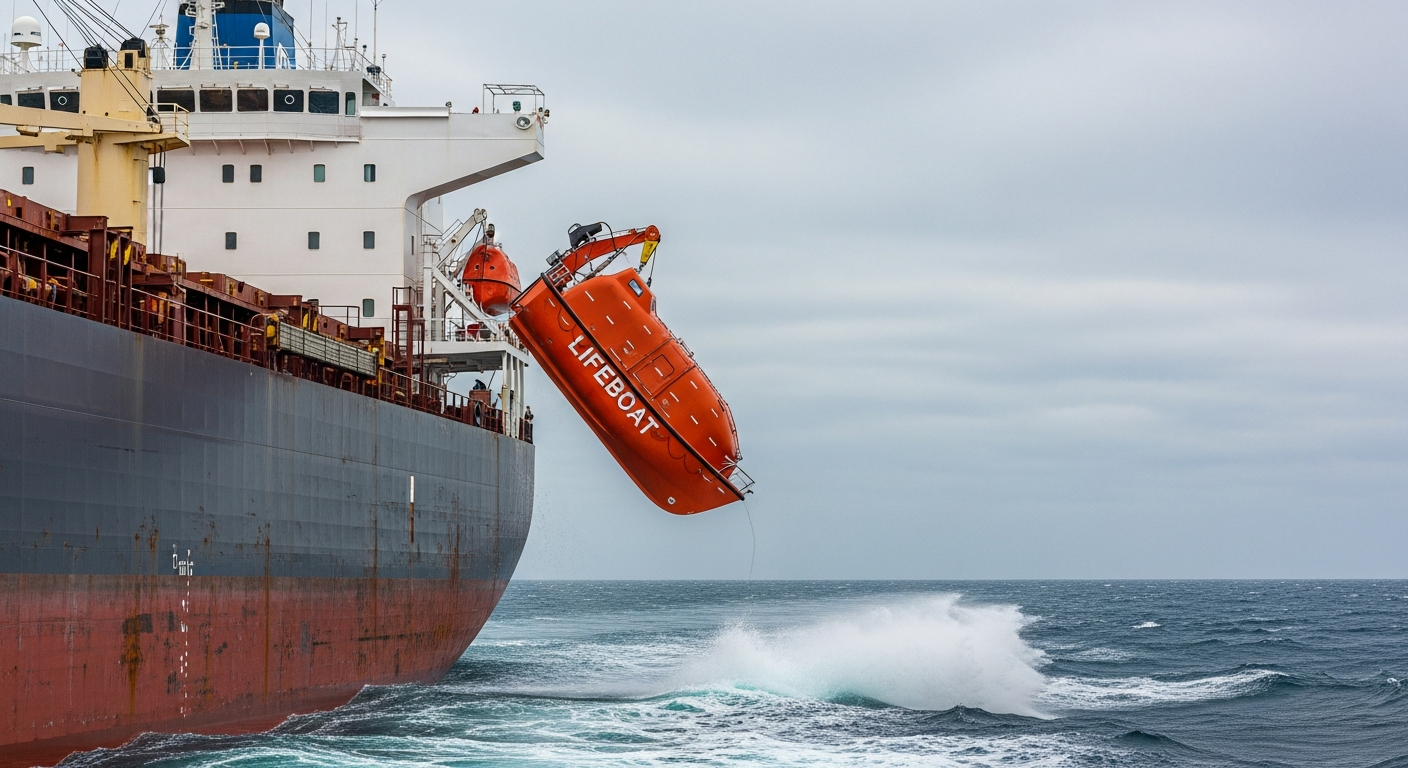
Free-fall lifeboats are engineered for rapid deployment, sliding stern-first into the water from an inclined ramp at the vessel's stern. This mechanism allows for swift evacuation in abandon-ship scenarios, accommodating up to 30 persons in a compact unit weighing around 4,400 kilograms and measuring 7.5 meters in length. Positioned typically 15 to 20 meters above the waterline at a 30-degree angle, these boats rely on precise hydraulic systems and release hooks to ensure controlled launches. Yet, as history shows, the very features that make them effective in crises can turn catastrophic during everyday drills if not handled with utmost care.
The Incident: A Routine Check Turns Tragic
On September 2, 2023, the Hong Kong-flagged bulk carrier Golden Zhejiang lay anchored in the serene waters of Trincomali Channel, British Columbia, Canada. This 292-meter vessel, with a gross tonnage of 92,270, was built in 2010 and was preparing for a cargo load. As part of standard weekly safety inspections mandated by international regulations, the deck crew accessed the free-fall lifeboat stowed at the stern. Their task was straightforward: verify the steering controls from inside the boat to confirm operational readiness.
What began as a routine procedure quickly escalated into an emergency. While troubleshooting a minor issue with the steering gear, a crew member inadvertently triggered the main release mechanism. In an instant, the lifeboat detached from its cradle and plummeted 19 meters into the channel below. The securing cables, intended only as temporary restraints, were not rated for load-bearing under dynamic forces. They snapped under the strain, allowing the boat to free-fall unchecked.
The sole crew member inside the lifeboat endured the full brunt of the impact. He suffered severe, life-altering injuries, including fractures, internal trauma, and partial memory loss that continues to affect his daily life. Fellow crew members on deck witnessed the horror but could only respond after the fact, pulling the injured sailor from the water and initiating medical evacuations. The vessel's master immediately notified authorities, halting operations until investigators arrived.
This event was no isolated mishap. It exposed deeper systemic flaws that mariners must recognize. A hydraulic fluid leak in the lifeboat's release system had plagued the equipment since at least June 2023. Noted in monthly safety logs, the defect went unreported in the planned maintenance system (PMS), depriving the engineering team of the chance to schedule repairs. Consequently, full-scale drills had been curtailed, leaving the crew less familiar with the boat's intricacies. In training simulations, this scenario illustrates how deferred maintenance can compound human error, turning a safety exercise into a survival ordeal.
Root Causes: Human Factors and Equipment Vulnerabilities
Maritime accident analyses often reveal a chain of events rather than a single failure point. In this case, the Transportation Safety Board of Canada (TSB) pinpointed several contributing elements during their thorough probe. First, the inadvertent activation of the release hook stemmed from inadequate familiarization with the control interfaces. Crew members, while experienced, had not conducted hands-on sessions inside the boat due to the hydraulic issue, eroding muscle memory for critical operations.
Second, the securing cables represented a design and procedural oversight. These ropes were meant for static mooring during storage, not to withstand the shock loads of an unintended drop. Lacking certification as structural supports, they provided a false sense of security. TSB emphasized that such improvised restraints are commonplace on many vessels, often overlooked in pre-drill checklists.
Compounding these was a cultural gap in reporting. The hydraulic leak, a slow drip that did not immediately impair function, was dismissed as non-urgent. This "fix it later" mindset, prevalent in resource-strapped operations, violates SOLAS (Safety of Life at Sea) conventions requiring proactive upkeep of life-saving appliances (LSAs). For trainee officers, this serves as a stark reminder: every anomaly, no matter how minor, demands documentation and escalation.
Broader data from TSB's archives paints a sobering picture. Since 1996, the board has probed seven similar incidents on commercial ships, each resulting in grave injuries. A parallel case unfolded in December 2020 aboard the bulk carrier Blue Bosporus during a drill in English Bay, British Columbia. There, wire rope slings holding the lifeboat in place sheared under tension, sending the craft crashing into the bay and hospitalizing two crew members with spinal and head injuries. These recurring patterns signal an industry-wide vulnerability, urging ship operators to revisit LSA protocols.
Lessons for Seafarers: Building Resilience Through Training
Incidents like this are not merely tragedies; they are teachable moments for the maritime workforce. The TSB's report calls for robust interventions to break the cycle of accidental releases. At the forefront is enhanced crew training. Mariners should undergo simulator-based sessions that replicate troubleshooting under pressure, emphasizing the "two-person rule" for all LSA interactions: no solo entries into lifeboats during maintenance.
Equipment integrity forms the next pillar. Operators must audit all securing devices, replacing non-compliant cables with certified alternatives capable of withstanding impact forces. Regular hydrostatic testing of hydraulic systems, coupled with leak detection kits, can preempt failures. Moreover, integrating digital PMS tools with automated alerts ensures defects trigger work orders without delay.
On the human side, fostering a just culture is key. Encourage anonymous reporting of near-misses through safety management systems, rewarding proactive identification over blame. For deck officers in training, role-playing incident debriefs can sharpen decision-making, while chief mates might lead workshops on SOLAS Chapter III compliance for LSAs.
The vessel's manager, Columbia Shipmanagement, which oversees more than 400 ships, responded decisively post-incident. They rolled out updated labeling on lifeboat controls for clearer identification, revised checklists for onboard familiarization, and installed adjustable turnbuckles on securing lines to distribute loads evenly. These measures, now standard across their fleet, exemplify how one vessel's lessons can safeguard thousands at sea.
Moving Forward: A Commitment to Zero Incidents
Free-fall lifeboats embody the maritime ethos of preparedness, but their dual role as potential hazards demands unwavering respect. The Golden Zhejiang saga reminds us that safety is a daily discipline, woven into every inspection and drill. By prioritizing training, maintenance, and accountability, seafarers can transform risks into routines, ensuring that when the call to abandon ship sounds, it is met with precision, not peril.
Aspiring and seasoned mariners alike: commit to these principles. Review your vessel's LSA manual today, simulate a release scenario with your watch, and report that nagging leak before it escalates. In the unforgiving ocean, vigilance is the ultimate lifeboat.
Source: Adapted from Transportation Safety Board of Canada (TSB) investigation report M23P0235, detailing the September 2023 incident on MV Golden Zhejiang. Full report available at: https://www.tsb.gc.ca/eng/rapports-reports/marine/2023/m23p0235/m23p0235.html
There are no comments.
Similar Posts
-
International Regulations for Safe and Efficient Container Shipping at Sea
Feb. 16, 2026, 7:31 a.m.
-
Top 10 ECDIS Mistakes Leading to Serious Port State Control Issues in 2025
Dec. 17, 2025, 9:55 a.m.
-
How a Single Minor Component Failure Triggered Grounding, Sinking, and Port Blockage
June 1, 2026, 8:04 p.m.
-
SAFER PILOT TRANSFER OPERATIONS: UNDERSTANDING THE NEW SOLAS V/23 AMENDMENTS
April 25, 2026, 6:55 p.m.