Dec. 17, 2025, 9:55 a.m.
As maritime navigation relies increasingly on Electronic Chart Display and Information Systems (ECDIS), Port State Control (PSC) inspections continue to highlight recurring deficiencies. These errors not only risk vessel detention but can also compromise safety and lead to accountability for the Master and bridge team. In 2025, with stricter enforcement under SOLAS and IMO guidelines, understanding these common pitfalls is essential for seafarers aiming to maintain compliance and operational excellence.
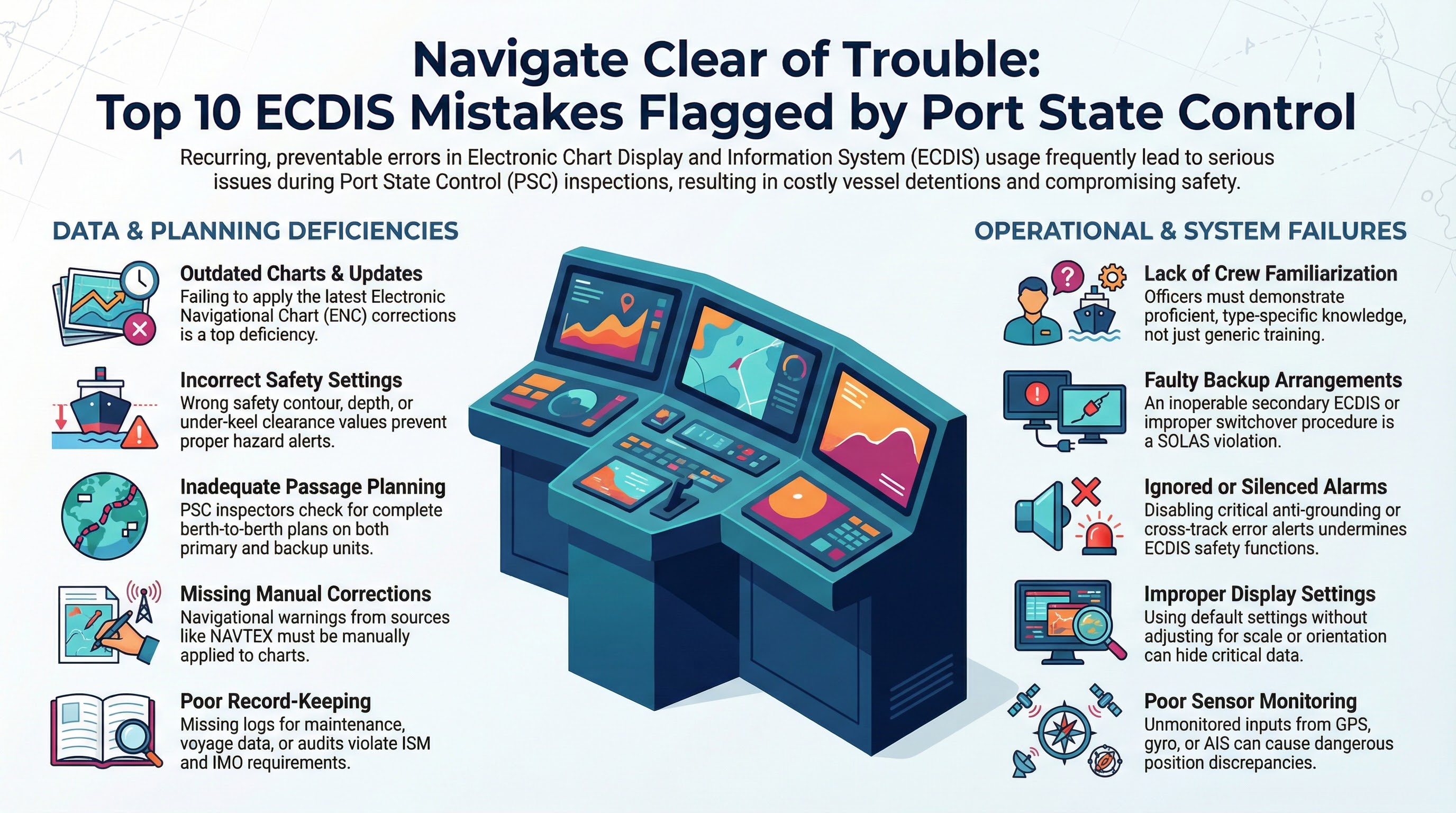
This article outlines the ten most frequent ECDIS-related mistakes observed during PSC inspections, based on recent trends from major MoUs like Paris, Tokyo, and others. Proper training, regular drills, and adherence to company SMS procedures can prevent these issues.
- Outdated or Incomplete ENC Updates Failing to apply the latest Electronic Navigational Chart (ENC) permits, corrections, or Temporary and Preliminary (T&P) notices is a top deficiency. PSC officers often check update logs and can easily spot missing corrections, leading to detainable items under safety of navigation codes.
- Incorrect Safety Parameter Settings Misconfiguring safety contour, safety depth, shallow contour, or under-keel clearance (UKC) values prevents proper hazard highlighting and alarm triggering. This remains one of the most cited issues, contributing to grounding risks and frequent PSC findings.
- Inadequate Passage Planning Incomplete berth-to-berth plans, lacking no-go areas, proper UKC calculations, or route safety checks, draw scrutiny. Inspectors verify full plans on both primary and backup ECDIS units.
- Lack of Familiarization and Training Bridge officers unable to demonstrate proficient ECDIS operation, such as route checking or alarm management, indicate ISM shortcomings. Generic training often falls short; type-specific knowledge is required.
- Faulty or Non-Functional Backup Arrangements Inoperable secondary ECDIS, improper switchover procedures, or missing backup plans violate SOLAS requirements. PSC drills test seamless transition during sensor failures.
- Ignored or Silenced Alarms Anti-grounding alarms, cross-track errors, or guard zone alerts disabled or treated as background noise undermine ECDIS safety functions. Inspectors check alarm histories and settings.
- Over-Reliance on Default Display Settings Using inappropriate scale (over-zooming), orientation, or display modes without adjusting for the voyage phase leads to misinterpretation of data, such as catzoc inaccuracies or datum shifts.
- Poor Sensor Integration and Monitoring Disconnected or unmonitored inputs from GPS, gyro, echo sounder, or AIS cause position discrepancies. Officers must verify sensor performance and handle failures correctly.
- Incomplete Manual Corrections Navigational warnings from NAVTEX or other sources not applied manually to ENCs result in outdated information, especially in areas without automatic updates.
- Inadequate Record-Keeping and Documentation Missing logs of ECDIS maintenance, voyage data recordings, or screen captures for audits fail ISM and IMO requirements. PSC expects clear evidence of ongoing compliance.
By addressing these errors through regular onboard training, pre-port checklists, and robust SMS integration, vessels can significantly reduce PSC risks. Masters play a key role in overseeing ECDIS use, approving plans, and ensuring crew competency.
Resource: IMO Resolution MSC.232(82) on ECDIS Performance Standards; Paris and Tokyo MoU Annual Reports.
There are no comments.
Similar Posts
-
International Regulations for Safe and Efficient Container Shipping at Sea
Feb. 16, 2026, 7:31 a.m.
-
Updated IMO Guidelines for Port State Control: Key Changes Effective from January 2026
Feb. 4, 2026, 9:22 a.m.
-
Safety Alert: Preventing Unintended Launches of Free-Fall Lifeboats
Nov. 22, 2025, 4:57 p.m.
-
How a Single Minor Component Failure Triggered Grounding, Sinking, and Port Blockage
June 1, 2026, 8:04 p.m.